
Next: 3D Reconstruction and Visualization
Up: Correspondence Analysis
Previous: Search for corresponding lines
Object detection
If corresponding edges have been found, the 3D position of these lines can be computed. But so far it is not clear which lines correspond to each other, thus which lines belong to objects. According to [SB97], objects can be detected searching for lines with approximately the same properties and opposite directions. Also intensity values could be used to detect objects. If two possible candidates of edges belong to an object, the intensity values to the right of the left edge are often similar to the intensities on the left of the opposite edge. Due to the given time constraints, this technique is not used, but for other applications it could be a good attempt. Another given fact is that the disparities of the borders of objects are often very similar. The dissimilarity between the disparities is proportional to the spatial difference in x-direction thus the allowed threshold between the difference in disparity can be related to the difference in x-direction.
In a mathematical manner, the object detection technique can be defined as follows:
 | (3.16) |
 and
 are the disparities of the left and right edge, respectively.
 and
 are the compare points,
 and
 denotes that the x alternatively y coordinate is used.
 is the length of the left line. The weights are set to

 = 10

 = 2

 = 50
It is not trivial to decide which weights yield the best result. So far the values have been empirically chosen, but sometimes false matches occur. A good attempt could be to let a neural network solve this problem. In the end it is just a linear classification problem in which the weights have to be chosen so that if a line corresponds to a line  , the rating
 should be maximal. In a mathematical formulation this would look like:
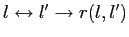 is maximal
 lines.
Next: 3D Reconstruction and Visualization
Up: Correspondence Analysis